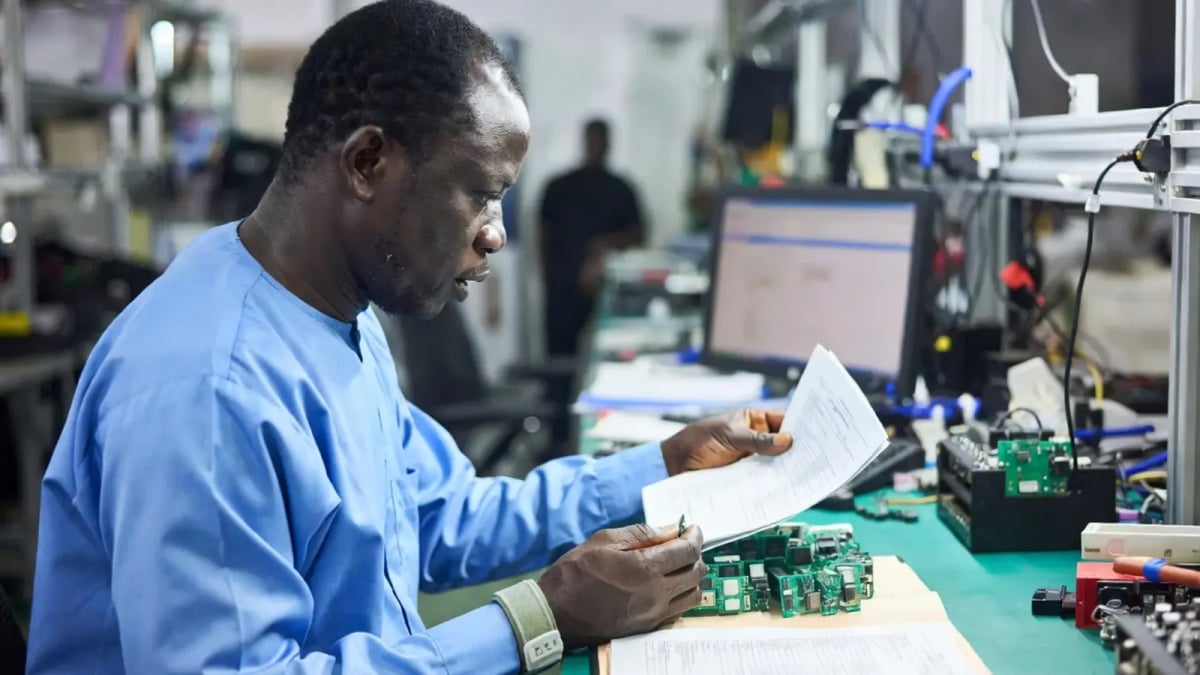
Electronic component sourcing for a manufacturing operation
An electronics assembly operation required reliable component supply with incoming-inspection and counterfeit-screening discipline. The Project Office structured a sourcing and quality-assurance programme with full chain-of-custody documentation.
Project Profile
Sector: Electronics manufacturing — printed-circuit-board assembly and sub-assembly production Scope: Multi-category component sourcing, inbound supply-chain structuring, and ongoing replenishment management Geography: Primary facility in Greater Accra Industrial Zone, with secondary intake coordination at a production site in Lomé, Togo Timeline: Initial sourcing engagement leading into a structured quarterly replenishment programme
Specification Challenge
A mid-scale electronics manufacturer operating across both Ghana and Togo had built its production capacity on an informal sourcing model — components acquired reactively, documentation inconsistent, and supplier relationships unmapped. As production volumes grew, the fragility of this model became operationally visible: line stoppages caused by component shortfalls, substitution errors introduced by undocumented lot changes, and procurement cycles that could not scale without breaking the production schedule.
The core challenge was not simply obtaining components. It was establishing a sourcing discipline rigorous enough to support a manufacturing operation that could not afford ambiguity at the handover points between procurement and production. Passive specifications — tolerance windows, packaging form factors, thermal ratings — had to be matched precisely. Any drift between what was ordered and what arrived carried direct production risk.
Approach
Kronix Silicon entered the engagement with a structured needs-mapping exercise, working alongside the client’s production and procurement teams to document the component categories critical to their assembly lines. Each category was mapped against passive specifications, acceptable lot parameters, and minimum replenishment lead requirements.
From this foundation, a sourcing programme was built around three disciplines: traceability at every handover point, documentation that travelled with each consignment from origin through to goods-in acceptance, and a replenishment schedule calibrated to the production facility’s actual consumption rhythm rather than approximated quarterly bulk orders.
For the Togo intake coordination, the programme accounted for the regulatory and logistical specifics of cross-border movement between Ghana and Togo, ensuring that documentation packages met the requirements of both receiving facilities without creating administrative delays at either end.
Where component categories carried substitution risk — instances where market availability might present near-equivalent parts — Kronix Silicon maintained a formal approval layer, ensuring that no substitution reached the production floor without a documented technical review.
Outcome
The manufacturer moved from a reactive, undocumented sourcing posture to a structured programme with consistent handover documentation, predictable replenishment cycles, and a traceable record for every component category entering production. Line stoppages attributable to sourcing irregularities reduced substantially across the first operational period under the new programme. The Togo facility, previously managed under an entirely separate and informal arrangement, was brought into the same documentation and replenishment discipline as the Accra operation.
The client’s procurement team reported a material reduction in the time spent managing supplier ambiguity — a function previously absorbing significant internal capacity.
What This Project Demonstrates
Electronics manufacturers in Ghana and Togo operate in environments where informal sourcing arrangements are common and initially appear functional — until production scale exposes their structural weaknesses. This project demonstrates the value of introducing sourcing discipline before a crisis forces the issue: mapping specifications formally, building traceability into every handover, and structuring replenishment to serve the production schedule rather than react to it.
The cross-border dimension — coordinating intake across both Ghana and Togo within a unified documentation framework — reflects the operational reality of manufacturers serving regional markets from multi-site production configurations. Kronix Silicon’s programme is built precisely for this geometry.