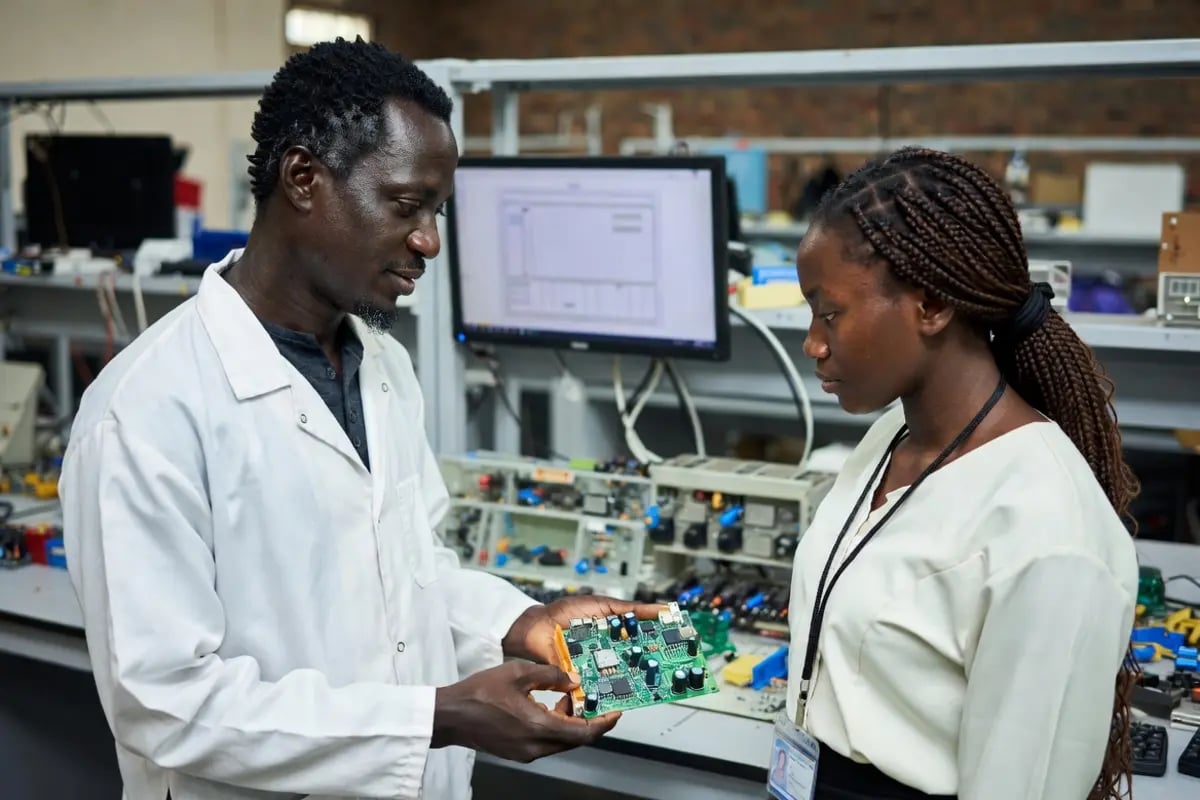
Why Research & Academic Institutions Specify Kronix Silicon
Research institutes and universities developing electronic systems operate under a discipline that is rarely visible to commercial procurement channels — the requirement that every component sourced must be traceable, datasheetable, and repeatable across iterative prototype builds. A single undocumented substitution can invalidate months of experimental data or introduce variance that corrupts a research finding entirely. Kronix Silicon understands this constraint not as an inconvenience but as the structural premise of its service: process-led sourcing in which every component handover is documented, every lot reference is recorded, and every specification is matched to the institution’s own technical brief.
Academic and research clients across Ghana and Togo also face a procurement environment that is unforgiving in its timing. Grant cycles, laboratory schedules, and thesis submission windows do not accommodate indefinite lead times. The Kronix Silicon supply-chain model is built for structured, repeatable sourcing — which means research teams receive consistent component availability across successive build phases, not a different product experience each time they place a requisition.
Specification Requirements Unique to Research & Academic Environments
Research-grade electronic development demands that components sourced for one prototype phase be documented precisely enough to be replicated in a subsequent phase — often months later, often by a different researcher. This places traceability at the centre of the sourcing brief: part numbers, manufacturer lot references, date codes, and datasheet revisions must all be captured at the point of supply. Kronix Silicon’s documented handover discipline satisfies this requirement by design rather than by exception.
Beyond traceability, academic institutions frequently specify components across a broad technical range within a single project — microcontrollers, passive components, power management ICs, sensors, and communication modules may all appear on a single bill of materials. The advisory layer that Kronix Silicon provides ensures that each line item is technically validated against the research specification before procurement proceeds, reducing the risk of incompatible component selections that would require costly redesign mid-project.
Recommended Services for Research & Academic Institutions
- Bill of Materials Advisory — technical review of research BoMs to confirm component availability, specification alignment, and datasheet accuracy before procurement
- Traceability-Documented Component Supply — sourcing with full lot reference, date code, and manufacturer documentation captured at every handover
- Prototype-Phase Replenishment Planning — structured supply scheduling aligned to laboratory build phases and grant-funded project timelines
- Specification Equivalency Review — identification of specification-matched alternatives when primary components face supply constraints, with full documentation of the substitution rationale
- Technical Advisory for Sensor and Embedded Systems Builds — specialist guidance on component selection for IoT, automation, instrumentation, and embedded research platforms
Notable Project Types
Kronix Silicon has supported research-institution procurement across Ghana and Togo spanning laboratory instrumentation builds, embedded systems development for academic robotics and automation research, and energy-monitoring prototype platforms developed within university engineering departments. Project scales typically range from focused single-researcher prototype builds through to multi-phase departmental research programmes involving coordinated component supply across several concurrent laboratory teams.
A recurring engagement pattern is the multi-semester electronics curriculum support brief, in which a technical institution requires consistent, documented component supply across teaching laboratory sessions — where repeatability of component specification from one academic cohort to the next is essential for curriculum integrity and assessment validity.
Compliance & Standards
- Full manufacturer datasheet documentation retained for every component line item supplied
- Lot reference and date code recording at each documented handover point
- Specification equivalency review conducted and documented before any substitute component is approved
- Supply scheduling aligned to grant-cycle and academic-calendar procurement windows
- Bill of materials reviewed against applicable research-project technical specifications prior to procurement execution
- Advisory outputs provided in written form to support institutional procurement records and research documentation requirements
Component Sourcing for Research & Academic Institutions
Kronix Silicon is an authorised-line component sourcing and distribution partner for research institutes and universities — not a semiconductor fab. We source genuine, traceable components across diverse, low-volume bills of materials, advise on specification, and document every lot for repeatable builds, drawing on these services:
- Electronic Component Sourcing & Distribution — Africa — the full sourcing programme
- Electronic Component Sourcing — BOM-matched procurement
- Obsolescence Management — last-time-buy & lifecycle planning for legacy lab equipment
- Quality Assurance & Testing — verification to the research specification
- Traceability & Compliance — documented provenance for grant and audit records
Genuine & To Standard
We source only through authorised and traceable supply lines, applying anti-counterfeit discipline aligned to recognised practice (AS6081 / AS9120 where applicable) and ISO 9001 quality practice — and we describe only the accreditations and authorised lines we actually hold. We are a sourcing and distribution partner, not a fabrication plant. Established 1998, serving Ghana, markets across Africa, and the Ghana–Togo (Lomé) corridor.
Request a sourcing quote — or discuss a supply programme: +233 20 531 3333.